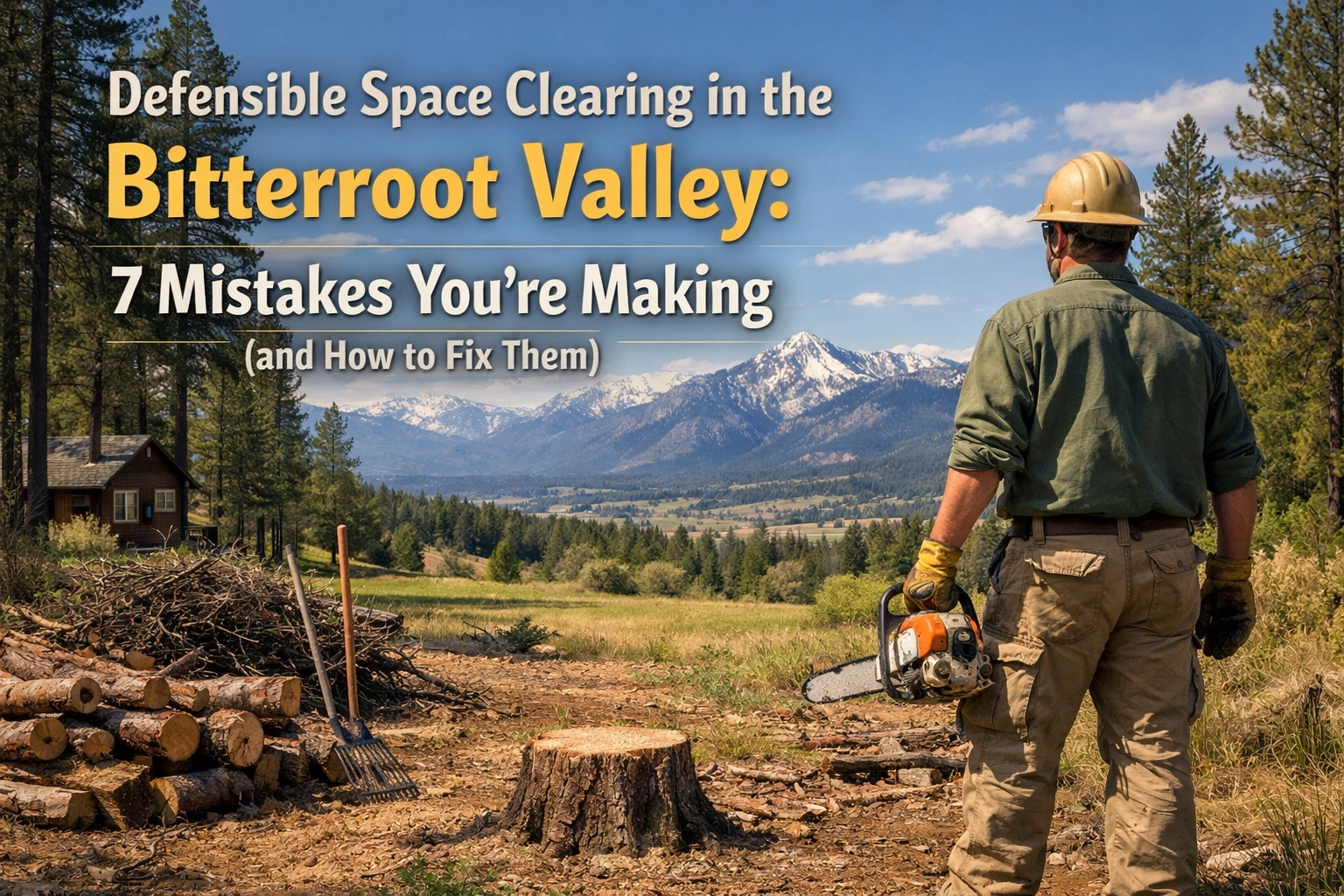
We live in one of the most beautiful valleys in Montana. We also live in one of the most fire-prone. Heavy forest fuels, steep terrain, and dry summers make defensible space clearing around your home absolutely critical. But after working with property owners across Ravalli County for years, I've seen the same mistakes repeated over and over.
Here's the thing: most people think they're doing defensible space clearing right. They're not. And that gap between what you think is safe and what actually protects your home during a wildfire? That's what keeps me up at night.
Let's fix that.
MISTAKE #1: STOPPING AT 30 FEET
Everyone knows the 30-foot rule. Clear vegetation 30 feet from your home. Check.
Except that's the bare minimum for Zone 1 defensible space, and it's often not enough in the Bitterroot Valley. Our steep slopes and dense forest fuels mean embers can travel further, and crown fires can spread faster than in flatter terrain.
The fix: Extend your defensible space to at least 100 feet where possible, especially uphill from your home. Gravity and wind push fire upward on slopes, so if your house sits below thick timber, that 30-foot zone won't cut it. We help property owners create multi-zone defensible space that actually matches the terrain and fuel load around their homes, not just a cookie-cutter distance.

MISTAKE #2: IGNORING THE HOME IGNITION ZONE
The area within 5 feet of your house is called the home ignition zone, and it's where most homes actually catch fire. Not from flames touching the siding, but from embers landing in pine needles piled against your foundation, dead leaves in your gutters, or that pile of firewood stacked against the garage.
The fix: This zone needs to be absolutely clean. No vegetation except low-growing, well-watered plants. No mulch (use gravel or rock). No combustible materials stored against the house. We often see decks piled with firewood, propane tanks right next to the back door, and years of pine needle accumulation under porches. Every single one of those is a direct ignition risk.
During our property walkthroughs, the home ignition zone is always the first thing we assess because it's the most critical and the most overlooked.
MISTAKE #3: LEAVING LADDER FUELS INTACT
You cleared the brush. Great. But did you prune the lower branches on your trees?
Ladder fuels are low-hanging branches and shrubs that allow ground fires to climb into the tree canopy, turning a manageable surface fire into a catastrophic crown fire. In the Bitterroot, where we have plenty of ponderosa pine, Douglas fir, and lodgepole pine, those lower branches are everywhere.
The fix: Prune branches up to 6-10 feet from the ground on all trees within your defensible space zones. For smaller trees, remove branches up to one-third of the tree's height. This creates vertical separation between ground fuels and the canopy, making it much harder for fire to climb.
We handle ladder fuel removal as part of our land clearing services, and we can mill any usable timber from larger branches instead of just chipping everything.

MISTAKE #4: NOT THINNING TREES ENOUGH
Thinning doesn't mean taking out two or three trees and calling it done. It means creating enough space between tree crowns so fire can't jump from one to another.
A lot of property owners are hesitant to thin aggressively because they like the privacy and the shade. I get it. But when tree crowns are touching or within 10 feet of each other, you've created a highway for wildfire.
The fix: Proper forest thinning means spacing trees so their crowns are at least 10 feet apart in Zone 1 (0-30 feet from structures) and 6 feet apart in Zone 2 (30-100 feet). Focus on removing smaller, weaker trees and keeping the largest, healthiest specimens. We prioritize removing dead, diseased, or damaged trees first, then thin for proper spacing.
This is where mobile sawmill services make a huge difference. Instead of paying to haul and chip everything, we can mill valuable timber right on your property and turn your fire mitigation project into usable lumber.
MISTAKE #5: LEAVING SLASH AND DEBRIS PILES
You did the work. You cut the trees, cleared the brush, pruned the branches. Now you've got massive piles of slash sitting on your property waiting for "someday" when you'll deal with them.
Those piles are fuel. Concentrated, dry, extremely flammable fuel sitting right there in your defensible space.
The fix: Remove or process slash immediately. Chipping is one option, but it's not always the best one. We often see property owners chip everything, then spread the chips around trees as mulch, which just creates a different fire hazard.
Better options: haul it off, burn it during safe conditions with proper permits, or let us mill the larger pieces and chip only the true waste. Don't let debris piles sit through fire season. In the Bitterroot's dry climate, slash dries out fast and becomes a liability.

MISTAKE #6: TREATING IT LIKE A ONE-TIME PROJECT
Here's the hard truth: defensible space isn't something you do once and forget about. Grass grows back. Brush returns. Pine needles accumulate. Trees drop branches.
In the Bitterroot Valley, with our relatively short growing season followed by dry summers, vegetation can rebound quickly in the spring and then become a tinderbox by August. Property owners who cleared their land five years ago and haven't touched it since often have fuel loads nearly as bad as before.
The fix: Plan for annual maintenance. Mow or clear grasses in late spring before they dry out. Remove pine needles and dead vegetation from around structures at least twice a year. Re-assess tree spacing and ladder fuels every few years as trees grow.
We offer ongoing maintenance services because we know this isn't a one-and-done situation. Regular walkthroughs and seasonal clearing keep your property actually safe instead of just temporarily cleared.
MISTAKE #7: DOING IT YOURSELF WITH THE WRONG EQUIPMENT
Look, I respect the DIY spirit. But defensible space clearing on multi-acre Bitterroot properties isn't a weekend chainsaw project. It's dangerous work that requires proper equipment, understanding of fire behavior, and knowledge of which trees to keep versus which to remove.
Every year we get calls from property owners who started a clearing project themselves, realized it was way more than they bargained for, and now have a half-finished mess and a pile of slash they don't know what to do with.
The fix: At minimum, get a professional assessment before you start cutting. We do property walkthroughs where we'll mark trees for removal, identify priority areas, and give you a realistic picture of what needs to happen. If you want to do some of the work yourself, fine, but let us handle the hazardous trees, the heavy thinning, and the slash removal.
Our equipment can handle steep terrain and dense timber that would take you weeks to clear by hand. Plus, with our mobile sawmill, we're not just removing fire risk, we're turning your trees into lumber you can use or sell.

WHAT ACTUAL DEFENSIBLE SPACE LOOKS LIKE
After we've worked on a property, here's what you should see:
Clean zone within 5 feet of all structures. No pine needles, no vegetation except maybe some rocks and gravel. Pruned trees with 6-10 feet of clearance below the lowest branches. Spaced canopies where you can see clear sky between tree crowns. No slash piles, no dead trees, no brush thickets. Grasses mowed or cleared before summer.
It should look maintained, not overgrown. It should look defensible, not decorated.
THE BITTERROOT REALITY
Our valley is special. It's also at serious risk. We've got the forest fuels, we've got the terrain, and we've got the weather patterns that make wildfire a when, not if, situation.
Defensible space clearing isn't about destroying your property's natural beauty. It's about making sure your home is still standing when the smoke clears. The homes that survive wildfires aren't the lucky ones: they're the prepared ones.
We've seen what happens when properties have proper defensible space versus properties that don't. The difference is stark, and it's not subtle.
LET'S WALK YOUR PROPERTY
If you're reading this and realizing you've made some of these mistakes, don't panic. Most property owners have. The important thing is fixing them before fire season hits.
Schedule a property walkthrough with Bitterroot Timber Solutions. We'll assess your current defensible space, identify the biggest risks, and give you a realistic plan for getting your property actually protected. No pressure, no sales pitch: just honest evaluation from someone who knows this valley and knows wildfire mitigation.
Contact us at Bitterroot Timber Solutions or give Jim a call. Let's get your defensible space actually defensible.
Comments are closed