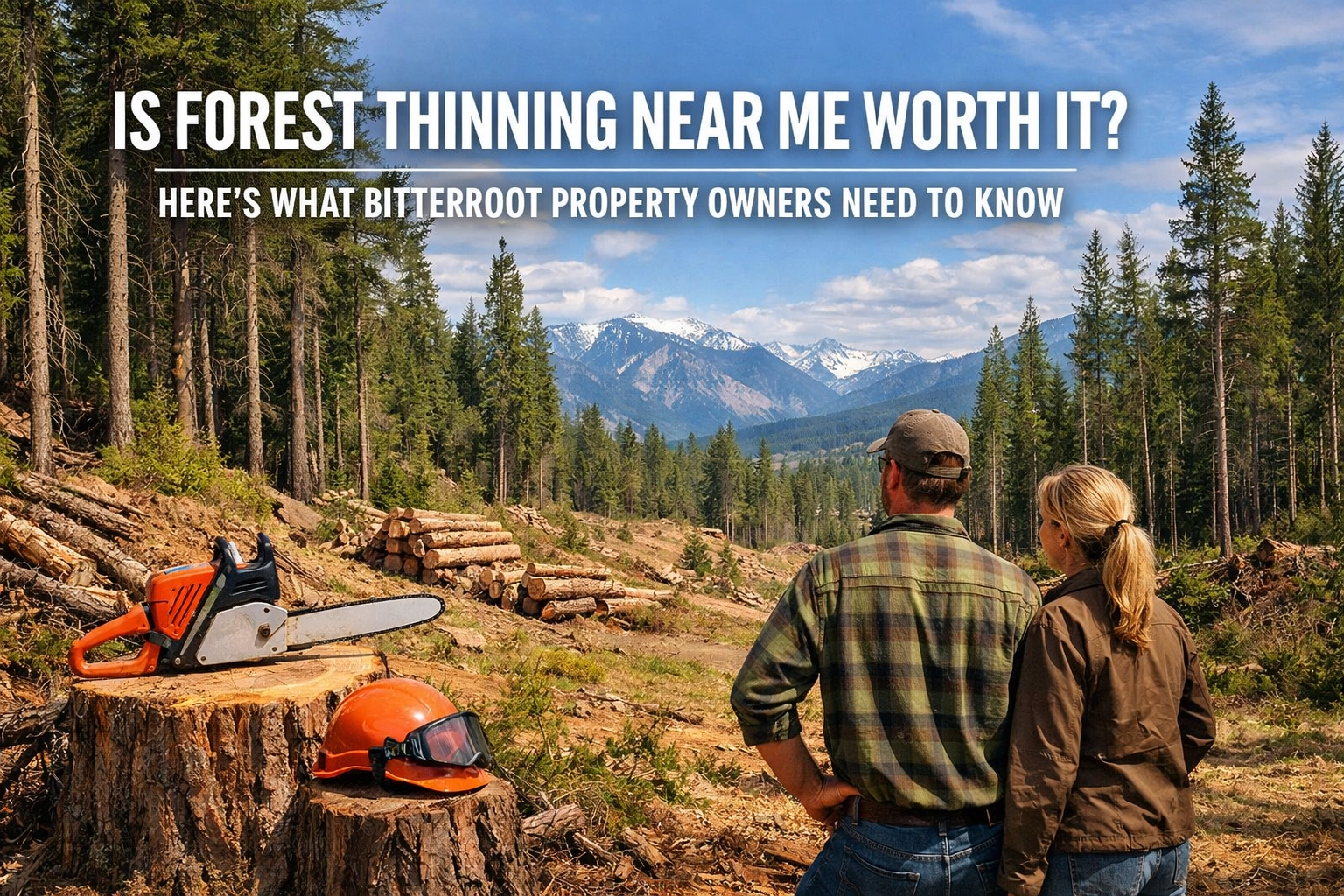
If you're typing "forest thinning near me" into Google at 11 PM while staring at your overgrown property, you're probably wondering two things: What exactly is forest thinning, and is it actually worth the money?
Short answer: For most Bitterroot Valley property owners, yes, it's worth it. But let's talk about why, what it costs, and what you're actually getting for your investment.
WHY FOREST THINNING MATTERS IN THE BITTERROOT VALLEY
Walk through any untouched stretch of forest around here and you'll see the problem immediately. Trees packed together like sardines, dead branches piled everywhere, and enough dry undergrowth to turn your property into kindling the moment a spark lands.
That's not what a healthy Montana forest is supposed to look like.
A properly managed forest has about 50-70 trees per acre. Fire-suppressed areas, which describes most of the Bitterroot, can have upwards of 15,000 stems per acre. That's not a typo. Fifteen thousand.
When trees are that densely packed, they compete for water, sunlight, and nutrients. They stay small and stressed. And when wildfire season rolls around, all that competition doesn't matter anymore, they just become fuel.

THE FIRE RISK REALITY
Let's be blunt: The Bitterroot Valley is a high-priority wildfire area. We've seen what happens when conditions align, Roaring Lion Fire, Lolo Peak Fire. These aren't distant memories. They're recent history.
Dense forests create what fire professionals call "ladder fuels." Picture this: a ground fire starts in the dry grass and brush. Normally, it stays low and burns out. But when you have thousands of small trees and branches creating a ladder from the ground to the canopy, that ground fire climbs straight up into the treetops. That's when you get a crown fire, the kind that moves fast, burns hot, and destroys everything in its path.
Forest thinning removes those ladders. You're essentially cutting the pathway that allows fire to explode from manageable to catastrophic.
The Bitterroot Community Wildfire Protection Plan specifically calls out our valley as needing fuels reduction work. Translation: This isn't just good practice. It's necessary.
WHAT THINNING DOES FOR TREE HEALTH
Here's something most people don't think about: Thinning isn't just about fire prevention. It's about making your forest actually healthy.
When you remove the excess trees, the ones that remain get access to resources they've been fighting for. More water per tree. More sunlight reaching the forest floor. Better air circulation. The result? Bigger, healthier trees that are more resistant to disease, drought, and pest infestations.
Plus, sunlight hitting the ground means grasses and native vegetation can grow. That's good for wildlife, especially elk and deer, and it's good for soil health. A forest floor that's just bare dirt and pine needles isn't doing anyone any favors.
Studies show that thinning combined with prescribed fire is the most effective long-term strategy for maintaining fuel reduction while restoring what mature Montana forests are supposed to look like. But even thinning alone makes a significant difference.

THE PROPERTY VALUE QUESTION
Nobody likes spending money without seeing a return. Fair enough. So let's talk about what forest thinning does for your property value.
First, it makes your land usable. Dense, overgrown forest isn't really accessible. You can't walk through it, you can't enjoy it, and you certainly can't build on it or use it for recreation. Thinning opens up your property.
Second, it drastically reduces insurance risk. Insurance companies are getting smart about wildfire exposure. Some are already refusing to cover properties in high-risk areas. Others are jacking up premiums. A well-managed forest with documented fuels reduction work can make a real difference when you're negotiating coverage.
Third, and this is specific to the Bitterroot, buyers care about this stuff now. Post-fire property values drop. Pre-fire mitigation increases marketability. If you ever plan to sell, having land clearing work done is a selling point, not an expense.

WHAT FOREST THINNING ACTUALLY COSTS
Here's where most people bail on the idea: cost. Historically, thinning private land in Montana was expensive, period. You paid someone to cut trees, haul them away, and got nothing back.
But things have changed.
First, Montana DNRC now offers grant programs that help residents pay for thinning operations. These grants are funded through the U.S. Forest Service specifically for fuels reduction work. You're not going to get the whole job covered, but it can significantly offset costs.
Second, companies like us with mobile sawmill services can turn your "waste" timber into usable lumber. Instead of paying to haul trees to a burn pile, you're converting them into something with actual value, fence posts, boards, firewood, whatever you need. That changes the economics completely.
Cost varies depending on property size, tree density, terrain, and access. But a typical land clearing project in the Bitterroot Valley for fire mitigation might run anywhere from $1,500 to $5,000 per acre depending on conditions. Grant assistance can knock that down considerably.
THE LONG-TERM SAVINGS MATH
Think about thinning as insurance you only pay for once (well, with occasional maintenance).
Compare the cost of thinning to:
- Losing your home in a wildfire
- Years of elevated insurance premiums
- Property value loss after a nearby fire
- Potential medical costs from smoke exposure during fire season
- The emotional toll of evacuating every summer when fires kick up
Even without a catastrophic fire, you're looking at ongoing costs if you don't thin. Overgrown forests require more aggressive intervention over time. Trees become more stressed and susceptible to beetle kill, which creates even more dead fuel. You're either paying now for prevention or paying later for crisis management.
Most property owners who invest in forest thinning report better peace of mind during fire season. That's not quantifiable on a spreadsheet, but it's worth something.

WHAT TO KNOW ABOUT BITTERROOT VALLEY SPECIFICALLY
A quick note: Large-scale thinning projects on National Forest land in the Bitterroot are currently paused while the Forest Service conducts additional environmental review. That's about grizzly bears, wolverines, and bull trout habitat concerns.
This doesn't affect private property work, but it's worth knowing because it reflects the balancing act between fire risk and ecological impact that's happening regionally. For your private land, you have more flexibility, and more urgency, to manage fuels on your terms.
The Bitterroot's unique situation (high fire risk, recent major fires, wildlife habitat concerns, proximity to populated areas) makes proactive land management especially important here. We're not in a low-risk zone. We're in the crosshairs.
SO, IS IT WORTH IT?
If you're a Bitterroot Valley property owner with dense forest, the answer is yes: forest thinning is worth it.
It's worth it for fire safety. It's worth it for forest health. It's worth it for property value and insurance purposes. And honestly, it's worth it for being able to sleep at night when the fire danger signs hit "extreme" every August.
The "worth it" calculation gets even better when you factor in grant funding and the option to mill usable timber instead of just hauling it away.
Is it cheap? No. But neither is rebuilding after a fire, or dealing with beetle-killed trees collapsing on your property, or explaining to your insurance company why you didn't take basic mitigation steps.
READY TO TALK ABOUT YOUR PROPERTY?
If you're in the Bitterroot Valley and you're tired of looking at overgrown forest wondering when (not if) fire season is going to be a problem, let's talk.
Bitterroot Timber Solutions offers land clearing, brush clearing services, and mobile sawmill work throughout the valley. We'll assess your property, discuss your options, help you understand potential grant funding, and give you a realistic picture of what forest thinning would look like on your land.
Contact us at Bitterroot Timber Solutions for a consultation. Let's figure out if thinning makes sense for your property: and if it does, let's get it done before next fire season.
Comments are closed