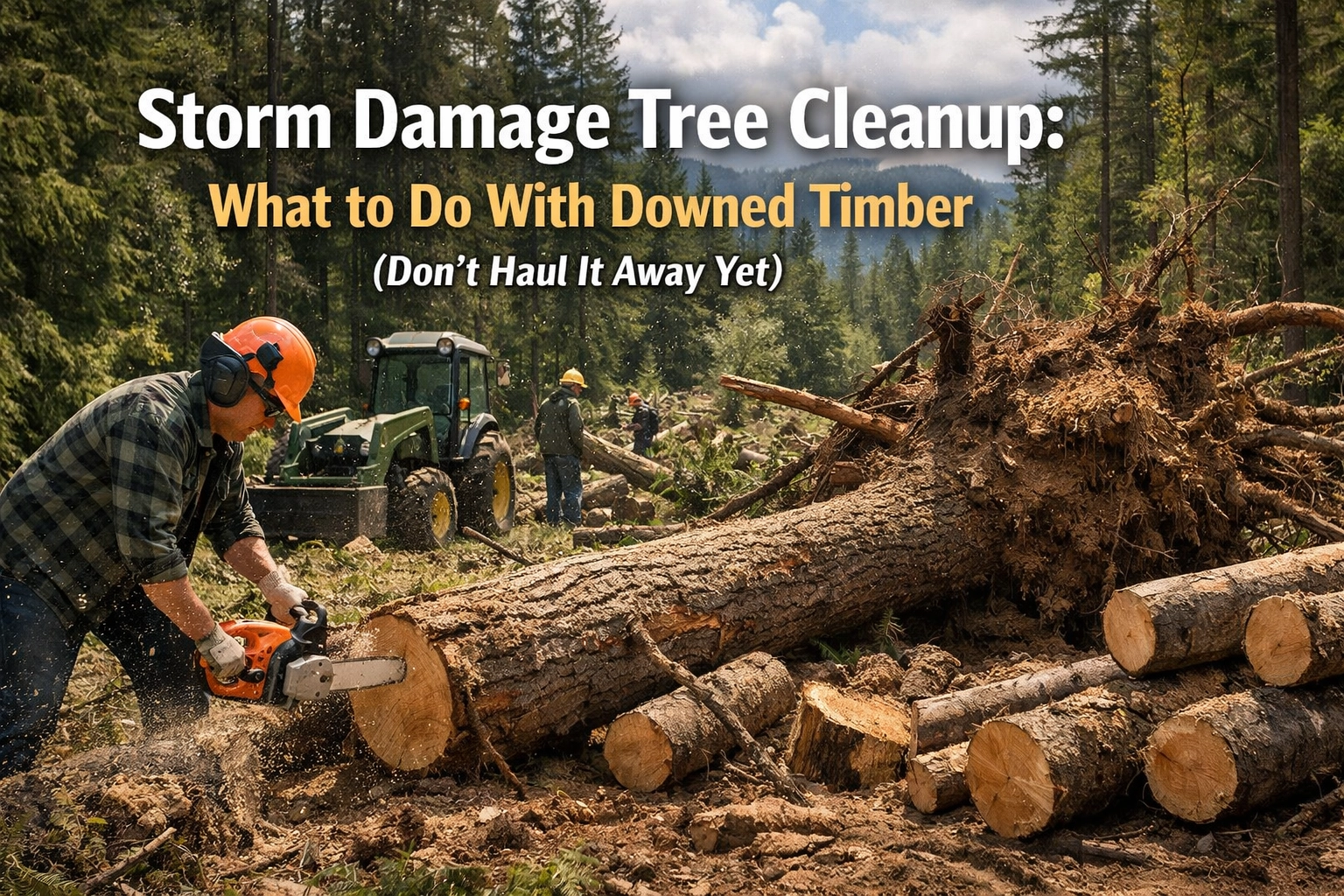
That windstorm last night knocked down three trees on your property. You're standing there looking at a massive pile of timber, already reaching for your phone to call someone to haul it all away.
Stop right there.
Before you pay someone to drag that wood to a burn pile or the landfill, let's talk about what you're actually throwing away. That "mess" in your yard could be turned into something useful, maybe even valuable.
THE IMMEDIATE AFTERMATH
Wind events in the Bitterroot Valley can drop trees fast. Chinook winds, microbursts, those weird spring storms that come out of nowhere, they all leave the same result. Downed timber, broken branches, and a yard that looks like a disaster zone.
Your first move is safety. Get away from anything near power lines. Don't touch branches that are still under tension or propped against other trees. If a tree is on your house or blocking your driveway, call professionals immediately for emergency storm damage tree cleanup.
But once the immediate danger is handled, slow down. Take a breath. That wood isn't going anywhere, and rushing to get rid of it might cost you more than just the hauling fee.

WHAT MOST PEOPLE DO (AND WHY IT'S A WASTE)
The typical response to storm cleanup goes like this: call a tree service, they show up with a chipper and a dump truck, they grind or haul everything away, you write a check.
Simple, right? Sure. Also wasteful.
Here's what just left your property in that dump truck: potential lumber for your next project, beams for a timber frame structure, firewood for the next three winters, unique slabs for furniture, even material you could sell to woodworkers.
Montana timber has value. Ponderosa pine, Douglas fir, lodgepole pine, these species aren't trash just because they fell during a storm. The wood quality doesn't change because of wind.
Most storm cleanup services treat everything as debris. Grind it, dump it, move on to the next job. They're not thinking about the grain in that fir tree or how those logs could be milled into dimensional lumber.
WHAT'S ACTUALLY IN YOUR PILE
Walk around those downed trees. Really look at them.
Any trunks over 12 inches in diameter? That's millable timber. Straight sections without major rot or damage? Even better. You're looking at 2x4s, 2x6s, fence boards, siding material, whatever you need.
Large branches can become smaller dimensional lumber or decorative pieces. Twisted, gnarly sections that wouldn't work for construction lumber might be exactly what a woodworker wants for live-edge furniture or artistic projects.
Even partially damaged logs have usable wood. We can work around the damaged sections during custom lumber milling, salvaging the good wood and dealing with the rest appropriately.
The key is assessment. Not every downed tree is worth milling, but you won't know until you actually consider it as material instead of debris.

THE MOBILE SAWMILL OPTION
This is where storm cleanup gets interesting.
Instead of hauling those logs away, we bring a portable sawmill to your property. We mill the timber right there, turning logs into usable lumber while you watch. No trucking fees to a distant mill, no waiting weeks for processing, no wondering what you'll actually get back.
Here's how storm damage tree cleanup looks with mobile sawmill services:
Assessment – We look at what fell, identify species, check for quality issues, determine what's worth milling.
Planning – You tell us what you need. Building a shop? We'll mill the lumber for that. Want slabs for tables? We can do that. Just need standard dimensional lumber you can use or sell? No problem.
On-site milling – We set up the sawmill on your property, process the logs, stack the fresh-cut lumber for drying.
Debris handling – Bark, sawdust, unusable sections, we deal with all of it. You're not left with a different kind of mess.
You end up with a stack of lumber cut to your specifications, not a yard full of wood chips and an empty wallet.
Cost-wise, factor in what you'd pay for hauling and disposal, then subtract the value of the lumber you just created. Storm cleanup services that include milling often break even or come out ahead, especially if you were planning any construction projects anyway.
WHAT ABOUT THE SMALLER STUFF
Not everything needs to go through a sawmill. Branches, limbs, and smaller debris have their own uses.
Firewood – Obvious but worth mentioning. Let branches dry properly, cut to length, stack it. Free heat for next winter. Ponderosa and Doug fir make excellent firewood once seasoned.
Wood chips and mulch – Rent a chipper or have us bring one. Fresh chips work great as garden mulch, path covering, or erosion control on slopes. They break down slowly and improve soil over time.
Hugelkultur beds – Stack logs and branches in garden beds, cover with soil. As the wood decomposes over years, it creates incredible growing conditions while sequestering carbon.
Habitat piles – Stack some brush in a corner of your property. Wildlife will use it. Birds, small mammals, beneficial insects all need cover.
Biochar – If you're into soil amendment, controlled burning of small branches can create biochar for garden use.
The research backs this up. Municipalities across the country are moving away from simply landfilling storm debris. The material has too much value. Composting programs, community chipping sites, wood reuse initiatives, everyone's figuring out that trees are resources, not trash.

WHEN TO ACT, WHEN TO WAIT
Timing matters with storm damage tree cleanup.
Act fast if:
- Trees are on structures or creating safety hazards
- Downed timber is blocking access roads or driveways
- Material is in contact with power lines
- Fire danger is high and dead wood creates risk
You can wait if:
- Trees are down in open areas with no safety concerns
- You want to assess milling potential
- You're planning construction projects that could use the lumber
- You want to get multiple estimates and options
Wood doesn't spoil immediately. Yes, insects and rot will eventually set in, especially in contact with ground moisture. But you have weeks, sometimes months, to make decisions about valuable timber.
Spring storms that drop green, living trees? That timber needs to be milled relatively soon to prevent staining and checking as it dries. Winter deadfall or already-dead trees? Less urgency, though sooner is still better than later.
MAKING THE CALL
Next time wind knocks down trees on your Bitterroot Valley property, pause before you call for standard storm cleanup services.
Look at what fell. Consider the species, the size, the straightness of the trunks. Think about projects you've been putting off because lumber prices are insane. Wonder if there's a better option than turning potential into wood chips.
There usually is.
We handle storm damage tree cleanup throughout the Bitterroot Valley with an eye toward salvaging value, not just clearing debris. Mobile sawmill, experienced assessment, practical solutions that work for Montana property owners.
Get a cleanup and milling estimate and let's see what your storm damage is actually worth. That pile of "trash" in your yard might be more valuable than you think.
Comments are closed